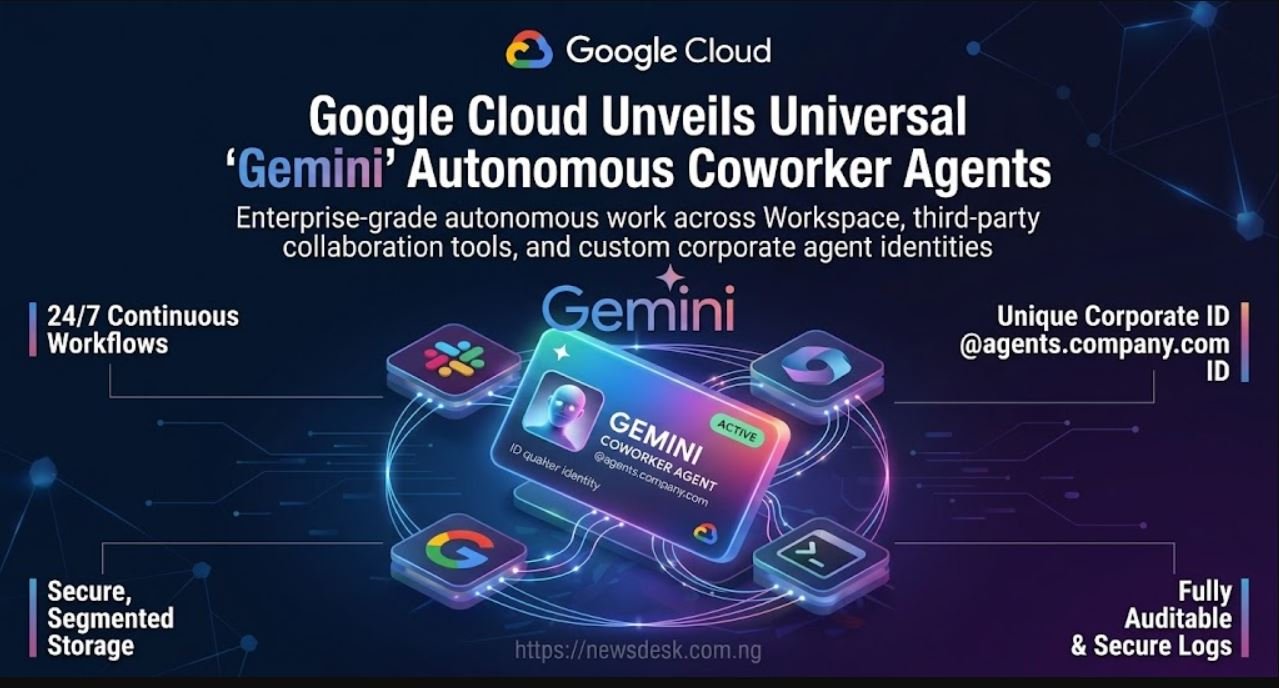
Google Cloud has announced the Gemini agent, describing it as a universal agent for work that can accept objectives, plan tasks, use business tools and return completed work. Announced at Gemini at Work 2026, the system is intended to operate across Google Workspace, developer environments and third-party services. It is currently in private preview, with wider availability planned for select Workspace Business and Enterprise plans.
Google wants users to delegate outcomes
The phrase “objectives, not instructions” captures the product’s intended shift. Instead of telling software every step to perform, a user could request a project update, meeting or analysis and allow the agent to identify the necessary information and actions. Google says the agent can answer questions, create content and write or run code.
This approach depends on organisational context. An agent asked for the latest project update must know which project matters, where current records live and what format the recipient expects. Without dependable access to that context, autonomy can amplify ambiguity rather than eliminate tedious work.
A single agent with multiple working identities
Google presents Gemini as more than a personal assistant. It can act on behalf of a team or a defined organisational role, such as a project manager or finance analyst. That makes identity and accountability central design questions: colleagues need to know when they are dealing with an agent and whose authority it carries.
A work agent may also require its own access to calendars, documents and communication channels. Administrators will need clear provisioning and offboarding processes, just as they do for human staff and service accounts. Persistent access without named ownership would make audits and incident response unnecessarily difficult.
Model routing and sub-agents sit underneath
The Gemini agent can select among models for different jobs, including Gemini and Claude families, according to Google’s announcement. It can also coordinate sub-agents for multi-step workflows, with some tasks running sequentially and others in parallel over hours or days.
This architecture treats the top-level agent as an orchestrator rather than a single model answering one prompt. The design may improve flexibility and cost control, but it also creates more places where an error can enter. A finished result needs traceability across model calls, tool use and intermediate decisions.
Memory makes continuity possible—and governance necessary
Google describes session, semantic, procedural and episodic memory. Together, these allow the system to retain task state, build structured knowledge, learn how work is performed and remember previous actions. Such continuity is essential for projects that extend beyond one conversation.
Memory also raises questions about retention, correction and access. A mistaken fact stored as organisational knowledge could influence later work unless users can inspect and amend it. Enterprises should ask where memories are stored, who can see them, how long they persist and whether they respect existing document permissions.
Security and spending controls are part of the pitch
Google emphasises administration, governance and built-in cost controls alongside capability. Those features are not optional extras for enterprise agents. A system that can send messages, modify documents or execute code needs limits that match the risk of each action.
Organisations should distinguish between reading information and taking external action. Drafting a project update carries a different risk from emailing it to clients. Approval thresholds, spend caps, action logs and the ability to revoke access quickly will be essential when moving from demonstrations to daily operations.
Integration could be the decisive advantage
Gemini’s presence in Gmail, Docs, Sheets, Slides and Chat gives it direct proximity to everyday work. Support for Slack, Microsoft 365, command-line environments and APIs extends that ambition beyond Google’s own applications, including headless deployments without a dedicated interface.
Yet integration quality will matter more than the number of logos supported. Permissions must survive across systems, data must remain current and failures must be visible. A workflow that stops halfway through should not leave users guessing which messages were sent or which records were changed.
How companies should prepare for the preview
Before deployment, businesses can select a bounded workflow with measurable results and limited downside. A recurring internal report is a safer starting point than an unsupervised customer negotiation. Teams should document the current process, define what completion means and identify actions that always require approval.
The private-preview status means important operational details may still evolve. Early adopters should avoid building critical dependencies on uncertain availability or pricing. Gemini agent represents a serious attempt to make AI a persistent workplace participant, but successful adoption will depend on controls and process design as much as model intelligence.
Frequently asked questions about Gemini agent
Is Gemini agent generally available to every Workspace customer?
No. Google introduced it in private preview and described wider availability as coming for select Business and Enterprise plans. Organisations should verify current eligibility before including it in operational plans.
Can it work outside Google applications?
Google described connections with third-party services, including Slack and Microsoft 365, as well as API and command-line access. The usefulness of each connection will depend on permissions, configuration and the specific workflow.
What is the safest way to begin?
Start with a low-risk internal process, define completion criteria and require approval before external actions. Logs, spending limits, access reviews and a named business owner should be established before expanding to consequential work.
Source: Google.
